
SAP to Odoo Migration: The Phased, Zero-Downtime Method

The nightmare scenario is simple: your team shuts off SAP on a Friday night, fires up a new ERP system Monday morning, and discovers that inventory numbers are wrong, production orders are missing, and nobody can ship. That is a big-bang migration gone wrong. It does not have to work that way — a phased, engineering-driven approach removes the gamble entirely.
check
How ready is your business to move from SAP to Odoo?
Free check — only at Doodex.
Start the diagnostictakeaways
No big bang. A phased migration moves one module domain at a time — finance, inventory, MRP — while SAP ECC keeps running as a safety net.
Parallel run protects you. Both systems run simultaneously, with daily or weekly reconciliation. Rollback to SAP stays available until each cutover is confirmed.
Faster than S/4HANA. Mid-market manufacturers typically complete migration in months, not the 12–24 months a full S/4HANA program requires.
The 2027 deadline is real. SAP ECC mainstream support ends December 31, 2027. Extended maintenance costs climb and support scope narrows after that date.
A concrete 6-phase roadmap. Module sequencing logic, common mistakes, realistic timelines, and a path to get your own phased migration plan.
Why Big-Bang ERP Migrations From SAP Fail
A big-bang migration means shutting off every SAP module — finance, purchasing, production planning, warehouse — and switching the entire organization to a new system in a single cutover window, typically a weekend. SAP and Odoo have fundamentally different data models and process logic. Moving everything at once amplifies every mismatch into a potential production-stopping defect.
The failure modes are predictable: production stops because MRP data did not transfer cleanly, you cannot ship or invoice because sales orders are incomplete, inventory is inconsistent because stock was loaded into mismatched fields, and there is no fallback because SAP has already been switched off. These are not edge cases — they are the real risk of the big-bang approach.
Many SAP customers facing the 2027 deadline are also weighing rushed S/4HANA programs, which carry their own cost and timeline risks. Panic-driven cutovers create worse outcomes than staying on extended maintenance. The phased alternative removes this gamble.
The Phased SAP to Odoo Migration Principle
A phased ERP migration means moving one functional domain at a time — for example, Finance and Purchasing first — while your SAP system continues to handle every other module. Odoo's modular architecture allows for gradual implementation, so you are never replacing the entire SAP system at once. A controlled, phased migration process typically takes 16–24 weeks.
In practice, this pairs with a parallel run: both SAP and Odoo process the same transactions for a defined period, and your team reconciles key figures (inventory on hand, AR/AP balances, production output) daily or weekly. Only after the numbers match and module owners sign off does SAP step back from that domain. Zero-downtime is not magic — it is the result of aligning data migration, integration switchover, and user training before any SAP module is retired.
This phased approach has been shown to work even on enterprise-scale, multi-subsidiary migrations, where one entity is run as a pilot before the same pattern is rolled out to the others. Starting from a single pilot site reduces risk and builds confidence before expansion.
Want to see this method applied to a real manufacturer?
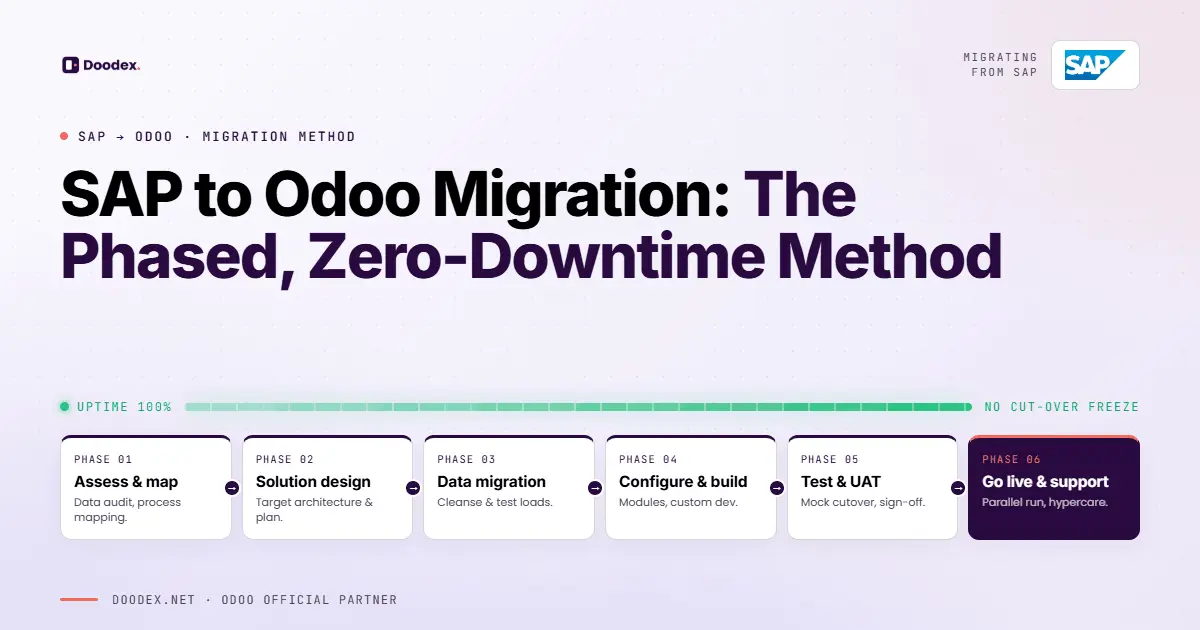
The 6 Phases of a Controlled SAP to Odoo Migration
The following six phases form a controlled, checkpointed process where each phase ends with specific deliverables before the next begins. For a typical mid-market manufacturer, the overall timeline runs a few months (estimated 4–8 months), depending on data complexity, number of integrations, and internal availability. Multiple phases overlap in time to shorten the total project duration.
Phase 1 – Assessment & Process Mapping
This phase typically takes 2–4 weeks. Core tasks include a complete data audit of your SAP system, reviewing custom ABAP objects, mapping current business processes, and creating a module mapping document with gap analysis. In a typical SAP-to-Odoo migration, 50–70% of legacy custom code becomes obsolete rather than being rebuilt.
Phase 2 – Solution Design
This phase usually lasts 2–4 weeks and produces the target Odoo architecture, hosting decision, and migration plan. Key decisions include Odoo edition, version selection, a high-level data migration strategy, integration architecture, and a training and change management plan.
Phase 3 – Data Migration: Strategy, Cleansing, and Test Loads
Data migration is the most technically complex part of ERP migration, often spanning 3–6 weeks. The strategy follows a clear order: master data first, then opening balances, then selected transactional history (typically last 1–3 years). As a general pattern, 15–20% of legacy SAP data turns out to be obsolete or inconsistent. Running at least 3 full migration test cycles before production cutover is crucial.
Phase 4 – Configuration & Development
This phase usually requires 4–8 weeks. Core tasks include defining companies, warehouses, routes, MRP settings, cost methods, and fiscal positions; configuring standard Odoo modules; and limiting custom development to real gaps. Custom development is often 30–40% lower than SAP's, built in an upgrade-safe way.
Phase 5 – Testing, Integration, and UAT
This phase typically takes 2–4 weeks and covers functional testing per module, integration testing with connected systems, user acceptance testing with key users executing full end-to-end scenarios, and a mock cutover to measure timing and expose bottlenecks before they become emergencies.
Phase 6 – Go-Live, Parallel Run, and Post-Migration Support
Go-live is scheduled in a low-activity window and follows a carefully scripted cutover plan. After go-live, SAP ECC stays available in read-only mode while Odoo handles live operations and figures are reconciled daily. "Hypercare" is an intensive 2–4 week support window. Odoo typically breaks even within 12–18 months when adoption and optimization stay on track.
30 minutes
See the Phased Method Applied to Your SAP Environment
Book a free 30-minute session with Doodex. We'll walk through your current SAP setup, map your modules to Odoo, and show you what a phased migration looks like for your specific plant — timeline, scope, and risk register included.
Book a free sessionWhich Modules to Migrate First (and Why)
Wave 1 — Finance, Purchasing, and Inventory: these anchor master data and cover the procure-to-pay and inventory valuation processes every other module depends on.
Wave 2 — Manufacturing (MRP, work centers, routings), Quality, and Maintenance: once core logistics and accounting are stable, production planning and shop floor modules follow.
Wave 3 — Advanced and peripheral systems: eCommerce, Customer Portal, advanced WMS, CPQ, or PLM integrations migrate after the core ERP system stabilizes.
Tailor this sequence when you face strong constraints. If a regulatory reporting deadline falls mid-project, push the relevant compliance module earlier. If your plant has a seasonal peak, schedule go-live outside that window.
How SAP ECC Stays a Safety Net During Migration
A parallel run means keeping SAP ECC operational while Odoo takes over specific domains. Both systems process the same transactions for a fixed period, and your team compares the outputs. Reconciliation routines include daily or weekly checks comparing inventory valuation, AR/AP balances, and production output between ECC and Odoo, plus module-owner sign-off required before SAP is retired for any given domain.
Rollback options exist during early parallel-run stages. If a blocking defect appears in Odoo's handling of a specific module, you can temporarily fall back to SAP for that domain without affecting the rest of the migration. This is the core risk-reduction mechanism — your plant never operates without a proven, running system underneath.
Not sure whether to stay on SAP, upgrade, or switch?
Common SAP to Odoo Migration Mistakes to Avoid
Replicating SAP one-to-one in Odoo. SAP workflows often carry years of accumulated complexity. Instead of copying every screen and report, redesign processes around standard Odoo flows — let Odoo simplify rather than replicate legacy complexity.
Underestimating data migration effort. Cleaning 10+ years of SAP data — duplicates, misaligned codes, inconsistent BOMs — consumes more hours than most project plans anticipate. Data quality issues are the top budget-buster.
Skipping user training and change management. Resistance to change is a common challenge. Involve your team early; user adoption depends on it.
Choosing an Odoo partner without cross-platform expertise. You need a team that understands both SAP and Odoo for correct data mapping, process design, and risk identification.
Shortening or skipping the parallel-run phase. This is not a time-saver — it is a risk amplifier.
Typical Timeline and Effort for a Phased SAP to Odoo Migration
For a single-plant manufacturer with tens to a few hundred ERP users, a phased migration typically runs a few months (estimated 4–8 months) from assessment to stable operations. By comparison, an equivalent full S/4HANA program usually takes 12–24 months. All of these figures are estimates, not guarantees.
| Phase | Typical Duration |
|---|---|
| Assessment & Solution Design | 1–2 months |
| Configuration, Data Migration, Testing | 2–3 months |
| Go-Live, Hypercare, Early Optimization | 1–2 months |
Multi-plant or multi-country rollouts follow a pilot-then-expand model. The first pilot site usually takes longer; subsequent entities go faster and often overlap.
Get Your Phased SAP to Odoo Migration Plan
A structured, phased SAP to Odoo migration avoids production downtime, data chaos, and the cost of rushed S/4HANA decisions. It is a controlled engineering process with checkpoints, reconciliation, and rollback at every stage.
To receive an initial roadmap tailored to your plant, share your current SAP version, user count, number of plants, and main modules. Your assessment will include a high-level data migration strategy, a module sequencing proposal, and a risk register customized to your business — along with estimated cost and timeline. Book a no-obligation Doodex consultation to validate whether a phased Odoo ERP migration fits your specific system landscape.
Planning your data migration from SAP to Odoo?
Free
Ready to Plan Your SAP to Odoo Migration?
Book a free 30-minute session with the Doodex team. We'll review your SAP landscape, map the phased migration path, and give you an honest picture of timeline, scope, and cost — before the 2027 deadline narrows your options.
Book your free sessionanswered
Can we migrate from SAP to Odoo in the middle of a financial year?
Yes, mid-year ERP migration is common. The typical approach is to establish a clear cut-off date, extract opening balances as of that date, and post remaining SAP-period transactions as summarized entries in Odoo. Local accounting rules and auditors should be consulted early to agree on documentation and audit-trail expectations.
What SAP data is usually migrated into Odoo?
Main categories include: chart of accounts, customers, suppliers, items/materials, BOMs, open sales and purchase orders, inventory quantities, and open AR/AP items. Full transactional history is typically retained read-only in SAP or moved to a data warehouse, while only the last 1–3 years of key transactions are migrated into Odoo for active reporting.
Can we run SAP and Odoo at the same time for an extended period?
Yes. Many businesses operate a hybrid period where SAP handles some modules (e.g., HR data, legacy plants) and Odoo runs others (e.g., a pilot plant or new business line). The parallel run is a deliberate tool that reduces go-live risk, not a problem to avoid.
How long does a phased SAP to Odoo migration usually take?
For a single-entity, single-plant manufacturer, typically a few months (estimated 4–8 months) from assessment to stable operations. Multi-company or multi-country rollouts are staged: longer for the first pilot, then faster per additional entity.
What kind of cost savings can we expect compared with staying on SAP?
Companies typically achieve meaningful savings through lower license fees, reduced maintenance costs, and faster Odoo development cycles. Odoo's total cost of ownership is significantly lower than SAP's. How much depends heavily on user count, complexity, and deployment model — the defensible figure is the one calculated from your own contract and scale.